


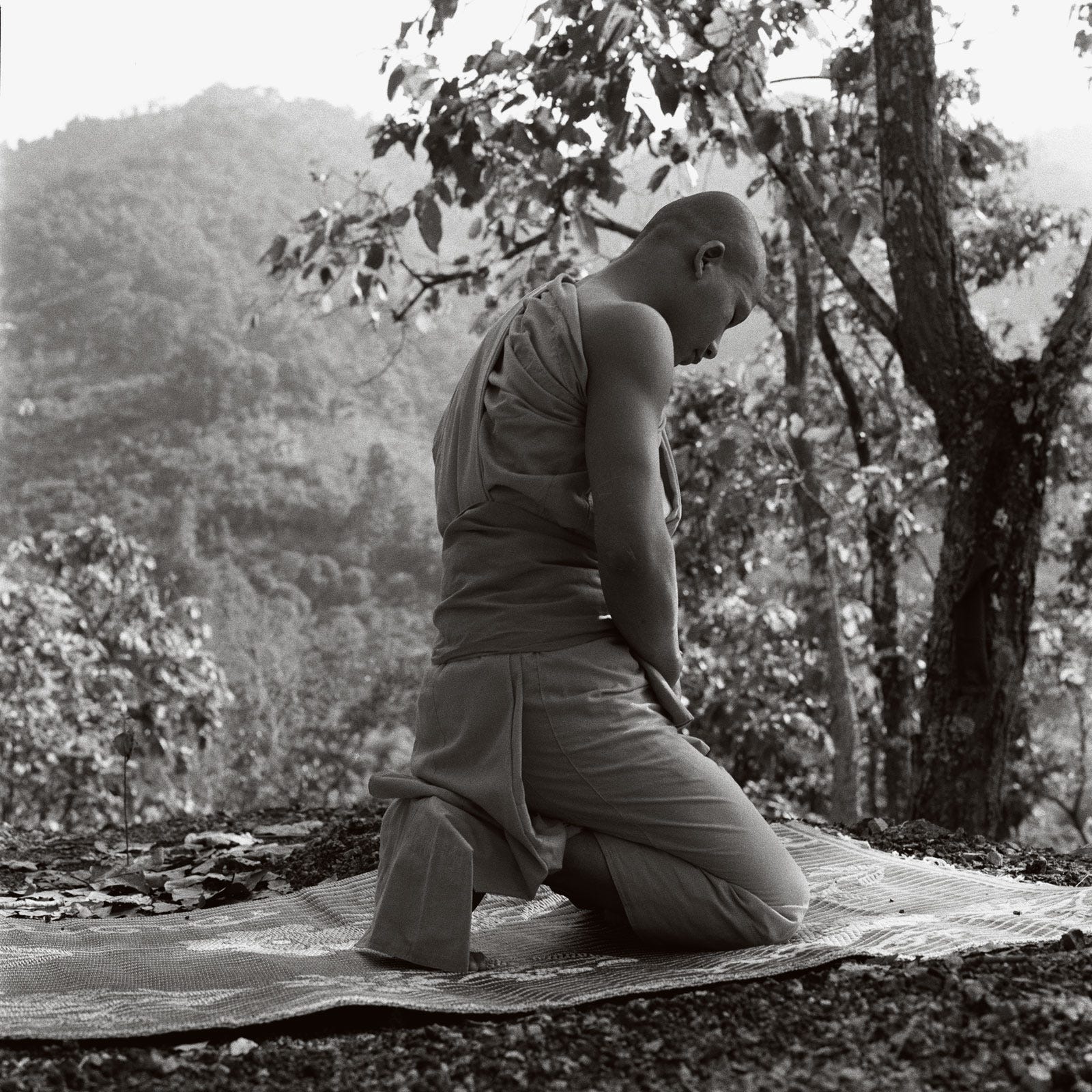
Even if you didn’t grow up in a culture that sanctified your sense of self—your self-esteem and independence—as human beings, we are hardwired to cling to our identities and all that comes with them. Our “I, me, mine.” This makes the Buddhist concept of not-self, one of Buddhism’s three marks of existence, particularly challenging.
Buddhism teaches that the solid and enduring self is a fallacy because all phenomena, including our selves, are interdependent and impermanent. A false sense of self propagates the stories we tell ourselves and the layers of suffering that pile on top. But if we can attend to how the fallacy manifests, we can break down the web of beliefs associated with it. As thirteenth-century Japanese Zen master Dōgen said in a well-known passage from the Genjokoan:
To study the Buddha way is to study the self. To study the self is to forget the self. To forget the self is to be actualized by myriad things. When actualized by myriad things, your body and mind as well as the bodies and minds of others drop away. No trace of realization remains, and this no-trace continues endlessly.
“Forgetting ourselves” doesn’t mean we don’t care. In fact, compassion arises when we realize that our stories are interwoven and we’re not separate from each other or the world. Any sense of lack dissolves and we find freedom in belonging.
This week’s Three Teachings reminds us that we’re not who we think we are, and that’s a good thing.
Long Journey to a Bow
By Christina Feldman
Recalling how the ritual of bowing helped her confront the conceit of self, meditation teacher Christina Feldman acknowledges how difficult it is to let go of our selves, which is why it’s said to be the last great obstacle to awakening. But we can cultivate right view both on and off the cushion, she says. “Life is a powerful ally because it offers us the opportunities to let go of the conceit of self…By liberating our minds from ideas of ‘better than,’ ‘worse than,’ or ‘the same as,’ we liberate ourselves from all views of ‘self’ and ‘other.’”
What Are You Really Afraid Of?
By David Loy
Arguing that our true fear is not of dying but of not existing in the first place, professor, writer, and Zen teacher David Loy explains that “when consciousness stops trying to catch its own tail,” we learn that we are whole, not nothing.
Did the Buddha Really Teach That There Is No Self?
With Thānissaro Bhikkhu
On a recent episode of Tricycle Talks, Thānissaro Bhikkhu, the abbot of Metta Forest Monastery in San Diego, CA, explained that the Buddha himself evaded answering the question of whether or not a self exists because, in the end, we shouldn’t cling to the answer. Not-self is a strategy, or skillful means, Thānissaro Bhikkhu stresses. What’s important is that we relinquish attachment to an idea of a fixed, isolated self, just as we do with attachments to anything else. With the emphasis on nonattachment, not on the ontological truth, we may all benefit from this teaching.
Coming up on Tricycle:
Sign up for Tricycle’s Buddhist Film Festival, online until June 30, to watch five feature films and five short films from around the Buddhist world. Get your tickets.
Join Rev. Amitha Khema, for an hour of guided meditation and discussion over Zoom at 11 a.m. ET on Monday, June 29 as part of Tricycle’s Meditation Group. Sign up here.
Join Sarah Shaw for a workshop on jhana over Zoom at 1 p.m. ET on Tuesday, June 30. Sign up here.
Become a paid subscriber to access everything on Tricycle’s website and Daily Dharma app, including 35+ years of teachings, over 500 Dharma Talks, weekly meditations, and monthly talks with leading Buddhist teachers and scholars.
What stories about yourself can you let go? What practices help you detach from a fixed sense of self? When has this freedom helped you in everyday life?
